
Return to: Emerge ACT
Resources for Clinicians
Below are resources for clinicians who may be diagnosing or treating patients with Myalgic Encephalomyelitis/Chronic Fatigue Syndrome (ME/CFS), Long COVID, Fibromyalgia, and comorbid conditions.
Diagnosis and management of ME/CFS and Long COVID

Clinical Education Online Learning Modules by Emerge Australia: Evidence-Based Education on ME/CFS and long COVID
Specialised training for medical and allied health professionals designed to improve patient outcomes through the latest research and clinical best practices.
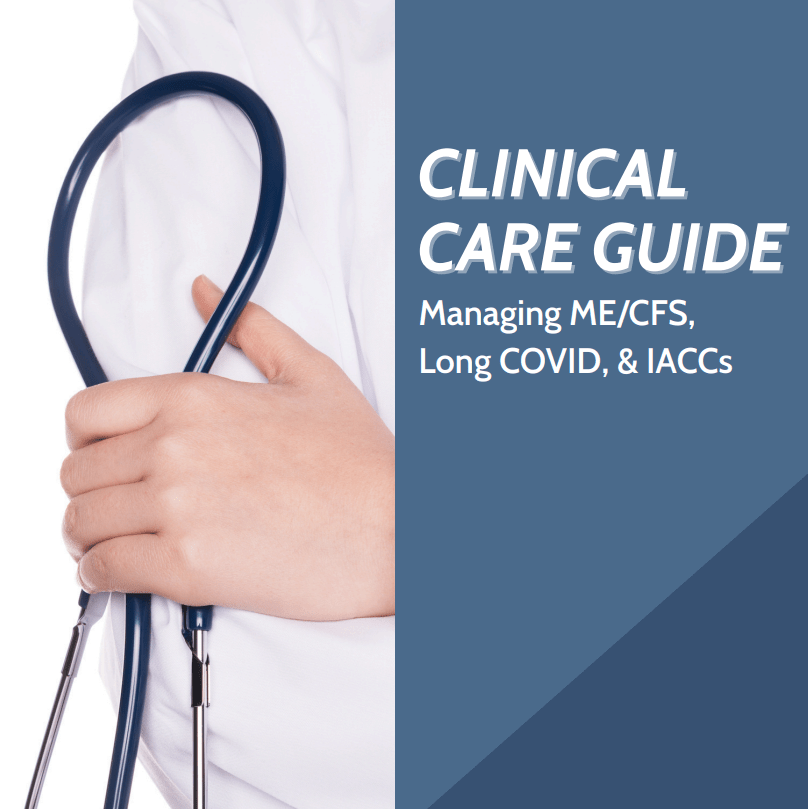
CLINICAL CARE GUIDE:
Managing ME/CFS,
Long COVID, & IACCs by Open Medicine Foundation (OMF) 2025
This guidebook serves as a practical resource for healthcare professionals seeking to better understand, diagnose, and manage ME/CFS, Long COVID, and other infection-associated chronic conditions (IACCs).
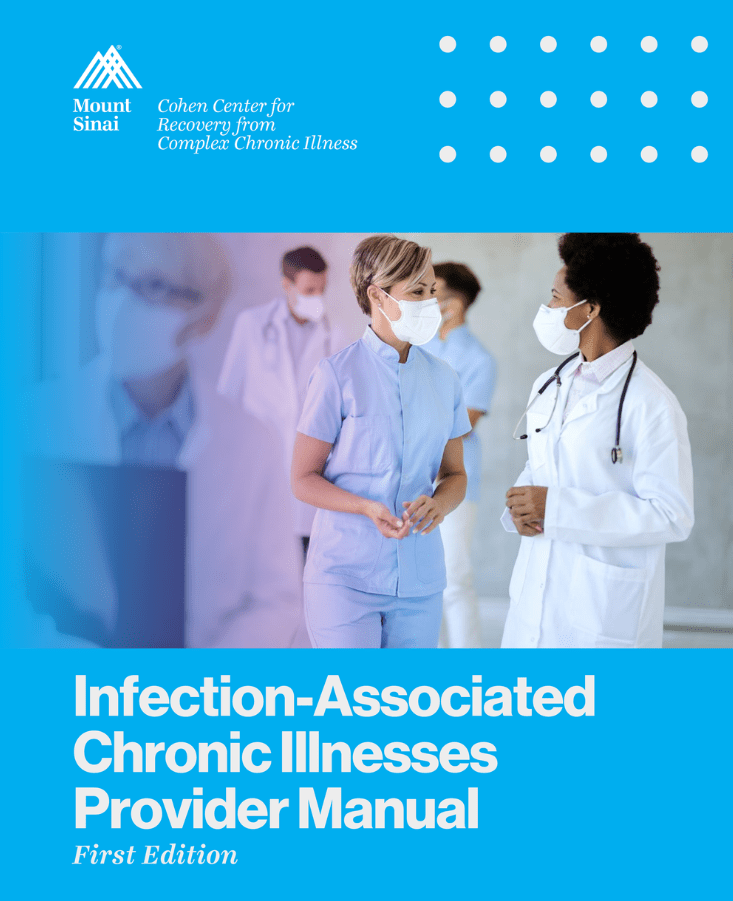
Infection-Associated Chronic Illnesses (IACI) Provider Manual by the Cohen Center for Recovery from Complex Chronic Illness (CoRE) at Mount Sinai 2025
This manual provides evidence-based guidance for clinicians working with patients affected by infection-associated chronic illnesses (IACIs), including long COVID, myalgic encephalomyelitis/chronic fatigue syndrome, and chronic tick- and vector-borne illnesses such as post-treatment Lyme disease syndrome.
Statement on the use of Graded Exercise Therapy (GET) and Cognitive Behavioural Therapy (CBT) as treatments for ME/CFS by Emerge Australia
In the past, graded exercise therapy (GET) and cognitive behaviour therapy (CBT) have been commonly recommended treatments for ME/CFS. GET has been based on the assumption that the symptoms of ME/CFS are largely the result of physical deconditioning due to lack of activity. However, biomedical research into ME/CFS does not support the deconditioning hypothesis of ME/CFS, and GET and CBT studies do not show the high rates of recovery and improvement which would be predicted by the deconditioning hypothesis.

Assessment tools for ME/CFS, Long COVID and commonly comorbid conditions
Fatigue and Post Exertional Malaise assessment
Good Day/Bad Day Questionnaire: captures function on baseline/good days and PEM/crashed/bad days and hours of
upright activity (HUA)
PROMIS Fatigue and Cognitive Function Questionnaires (recommended are 4a, 7a or 13a): provides a validated measure of fatigue severity compared to population norms. Information about validity and scoring can be found here
SF-36 [RAND-36] Functional Assessment Scale: measures health-related quality of life and daily limitations
FUNCAP – assists in documenting support needs and loss of independence across multiple domains. Developed specifically for ME/CFS and post exertional malaise.
FUNCAP55: offers more detail
FUNCAP27: shorter
DePaul Symptom Questionnaire – Post-Exertional Malaise short form (DSQ-PEM): Distinguishes PEM from generalised post-exertional fatigue seen in depression or deconditioning. Identifies the presence and severity of PEM.
Neuro-QOL Cognition Function Short Form: Assesses degree of cognitive functional impairment.
Orthostatic Intolerance and Dysautonomia assessment
NASA Lean Test: in-office passive standing test to assess for orthostatic intolerance
Malmö POTS Symptom Survey: designed to help identify symptom patterns consistent with Postural Orthostatic Tachycardia Syndrome (POTS). This brief survey can support initial diagnosis and can also be used longitudinally to monitor symptom progression or response to treatment
Active Stand Test: for use in clinical practice to support consistent assessment and documentation for POTS, template created by the Australian POTS foundation. How to undertake and interpret an Active Stand Test (AST) is available here.
COMPASS-31 Composite Autonomic Symptom Score: Assesses domains of autonomic dysfunction and severity.
Joint Hypermobility and hEDS screening and assessment
Five Point Questionnaire (5PQ) for Generalised Joint Hypermobility: a quick screening tool used to identify generalised joint hypermobility.
Diagnostic Criteria for Hypermobile Ehlers-Danlos Syndrome (hEDS): The clinical diagnosis of Hypermobile EDS is done by physical examination in conjunction with personal and family medical history.
Bateman Horne Centre video playlist: Talks for clinicians about ME/CFS and Long COVID
Diagnosis and management of Fibromyalgia
Resources for Clinicians for the Diagnosis and Management of Fibromyalgia by Fibromyalgia Australia
Information about management, comprehensive assessment, care planning, patient monitoring, pain management, complementary treatments and allied health.
Assessment tools for Fibromyalgia
Fibromyalgia Survey Questionnaire, Hauser 2012: to quantify the major symptoms of the syndrome.
Fibromyalgia Canadian Multisystem Questionnaire: to identify the range of the symptoms and domains.
2011 Fibromyalgia Michigan Body Map diagnostic tool: useful to determine the degree of Fibromyalgia or central sensitisation.
Patient education and support for ME/CFS, Long COVID & Fibromyalgia
In addition to medical and allied health support, a cornerstone of managing the effects of conditions like ME/CFS, Long COVID and Fibromyalgia is patient education, self-management and pacing. The reality is that these conditions are confusing, scary and disabling for those living with them, so the aim of patient education is to increase confidence, autonomy and (where possible) quality of life, as well as to validate the experiences of the patient. This is the focus of the services we provide at Emerge ACT.
We welcome referrals from allied health and medical professionals, especially for those living with debilitating fatigue conditions in the Canberra region. We provide:
- Peer mentorship for members living with debilitating fatigue conditions
- Weekly and monthly in-person and online support groups
- A carers support group
- Pacing and self-management courses (our 9-week Self-Help Course and ongoing Club Tortoise)
- Webinars on a range of topics for members
- Digital and print resources
- A members’ newsletter
- And more
Click the link below to find out more information about our current services. You can contact us at [email protected].
Links to other organisations
Patient support organisations
Fibromyalgia Australia (Bridges & Pathways)
The Australian POTS Foundation
Research organisations/projects
Open Medicine Foundation (Global & Australia)
National Centre for Neuroimmunology and Emerging Diseases (NCNED) at Griffith University
RMIT Long Covid Assessment and Management in Practice (LAMP) Project
The Cohen Center for Recovery from Complex Chronic Illness at Mount Sinai
Thank you for helping make a difference in the lives of those living with debilitating fatigue conditions.
Want more information? Contact us at [email protected].